Breathless Tales
She Rolled Her Husband's Wheelchair Off the Dock and Texted Two Words: "It's Done." He Walked In Behind Her.
Celeste was sure her husband couldn't walk, let alone swim. So she sent two words to someone and waited for her new life to begin. Then she heard wet footsteps on the marble floor.

Two Words
The message had no name in it. No explanation. Just two words.
*It's done.*
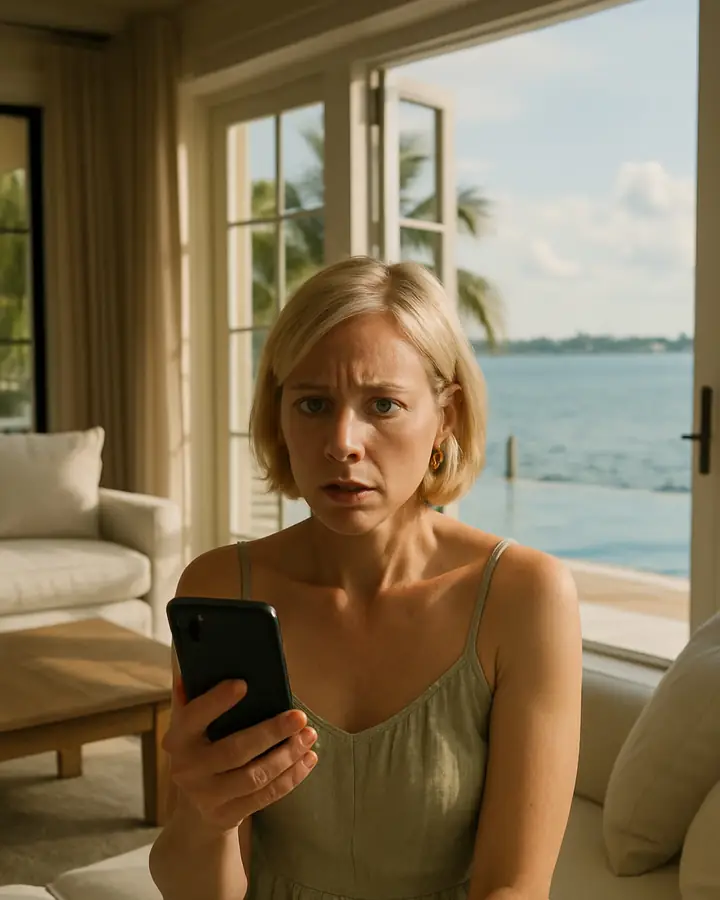
Celeste Whitaker pressed send, set the phone face down on the white sofa, and let out a breath she felt she'd been holding for a year.
Outside the glass doors of the villa in Islamorada, in the Florida Keys, the water was as calm as a painting. The long wooden dock ran straight out toward the yachts moored in the bay. At the very end of it, there was nothing at all.
Ten minutes earlier, there had been a wheelchair.
The Man Who Couldn't Stand
Grant Whitaker, forty-nine, had built a marine-supply business from one rented warehouse into a company with eleven locations from Key West to Fort Lauderdale. Then, fourteen months ago, a fall from a boat lift had damaged his spine. The doctors said he might never walk again.
Celeste, forty-two, with her platinum bob and her wide straw hat, had been the perfect wife in public. She pushed his chair to charity dinners. She held his hand in front of cameras. And, little by little, she began signing things for him.
"It's easier this way, honey," she'd say, sliding another folder across the table. "You need to rest."
What Celeste didn't know was that Grant had started to feel his toes in March.
He told no one but his physical therapist, a quiet man named Luis who came three mornings a week while Celeste was at her tennis club. Step by step, between parallel bars in the pool house, Grant learned to stand again. By August, he could walk the length of the pool. By September, he could swim it.
He meant to surprise her. He even planned the day.
Then, one night, through the open door of her study, he heard her on the phone.
"As long as he depends on me, we have time," she said softly. "Once the power of attorney is final, nobody can touch it."
Grant sat very still in his chair in the dark hallway. And he decided to stay in it a little longer.
The Edge of the Dock
That afternoon, Celeste offered to take him out to watch the boats.
The dock was warm under the sun. The only sound was the water slapping softly against the pilings. She pushed the chair slowly, all the way to the very end, and stopped closer to the edge than she ever had.
"Celeste," Grant said quietly, "why are we so close to the edge?"
She took off her sunglasses and looked at the yachts, not at him.
"Because after today," she said, "I won't have to push this chair anymore."
"Celeste..."
"Goodbye, Grant."
The water was cold and green and sudden. Celeste stood on the dock and watched the surface for a long time. The ripples spread, and faded, and the bay went smooth again. Her straw hat had blown off and floated quietly away on the current.
She didn't call for help. She turned around and walked back to the house.
She never looked under the dock.
Wet Footsteps
Grant had spent months preparing for a moment he prayed would never come. He'd unbuckled the strap before the chair ever touched the water. He'd let himself sink, swum under the dock, and waited in the shadows between the pilings, holding the old swim ladder, until her footsteps faded.
Then he climbed out. And he walked.
Inside, Celeste's phone buzzed on the sofa. A reply.
*Then tomorrow, it's all ours.*
She was already typing her answer when she heard it behind her. A sound on the marble floor.
One step. Two. Three.
She turned.
Grant stood in the open doorway, soaked to the skin, water running from his white linen shirt onto the floor. Standing. On his own two feet.
The first thing he looked at wasn't her face. It was the glowing screen in her hand.
She tried to hide it. Too late.
"Who were you texting?" he asked.
She didn't answer.
Grant reached into the pocket of his wet trousers and held up a small black flash drive, sealed in a plastic bag.
"Maybe the same person whose name is in these files?"

The Name in the Files
For six weeks, while Celeste believed he was napping, Grant had been copying documents from the home office. Bank transfers. Draft contracts. A power of attorney that would hand her control of the company the moment a doctor signed off on his "permanent incapacity." One name appeared on almost every page as an advisor.
Russell Voss. The financial planner Grant himself had hired four years earlier.
"Give me your phone, Celeste," Grant said, and held out his hand.
She pressed it against her chest. "No."
That single word erased his last doubt.
But Grant hadn't come back alone. Before he ever walked up from the dock, he had stopped at the pool house, where Luis was waiting, and made one phone call. Now car doors closed in the driveway.
Detective Andrea Moreno of the Monroe County Sheriff's Office stepped into the living room with two deputies. Grant had first called her three weeks earlier, after the night in the hallway. She had told him to keep collecting everything he could, and to stay safe.
"Mrs. Whitaker," she said, "I'm going to need that phone."
Tomorrow Never Came
The texts, the files, and the reply that read *Then tomorrow, it's all ours* were enough. Russell Voss was arrested the next morning at his office in Miami, before he ever reached the bank. Investigators found he had done the same thing to two other clients. Celeste Whitaker was charged with attempted murder and fraud. Her lawyers advised her to plead guilty. She did.
The power of attorney was never filed. The company stayed in Grant's hands, and he gave Luis a permanent job running a free rehabilitation program for injured dockworkers.
The following spring, Grant walked to the end of the dock on his own, slowly, with a cane he barely needed. He sat on the edge with his feet above the calm turquoise water and watched the boats come in.
There was no chair behind him anymore. For the first time in a long time, nobody was pushing him anywhere.
◆ ◆ ◆
Fiction. Any resemblance to real persons or events is purely coincidental.