Breathless Tales
The Hidden Button That Unveiled a Dark Dynasty
The Hidden Button That Unveiled a Dark Dynasty

Discovery in the Night
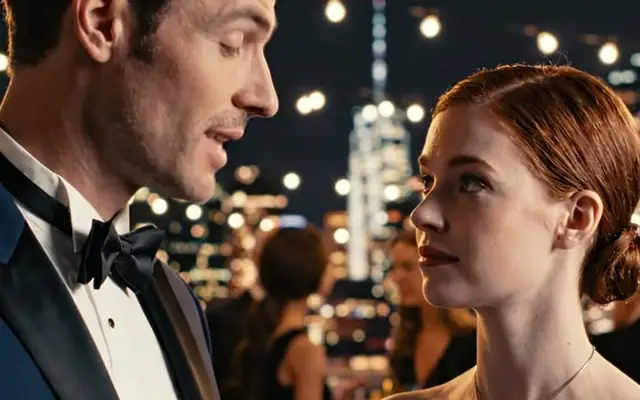
Ethan had always felt like an interloper amid the glittering opulence of his family’s penthouse. The crystal chandeliers threw prisms across the marble floors, and the murmuring elite seemed to glide on a sea of champagne and whispered fortunes. Yet beneath the polished veneer, a hollow echo resonated within him—a sense that the world he inhabited was a stage set for a story he had never been allowed to read. On a night when the city’s neon veins pulsed beyond floor‑to‑ceiling windows, he found himself drifting away from the clamor of polite conversation, drawn instead to a quiet corner of the lounge where the ambient light fell in a softer, more forgiving hue.
His eyes caught a faint irregularity in the painted wall—a small patch where the glossy finish had begun to peel, exposing the raw plaster beneath. It was an almost imperceptible flaw, the kind that would go unnoticed by anyone who wasn’t looking for it. Ethan’s curiosity, honed by years of feeling invisible, compelled him to investigate. He slipped a discreet scraper from his pocket, a tool he kept for moments when a mystery begged to be uncovered, and gently lifted the flaking layer. Beneath the dust lay a brass button, cold and inconspicuous, set flush against the wall as if it had been waiting for the right hand to press it.
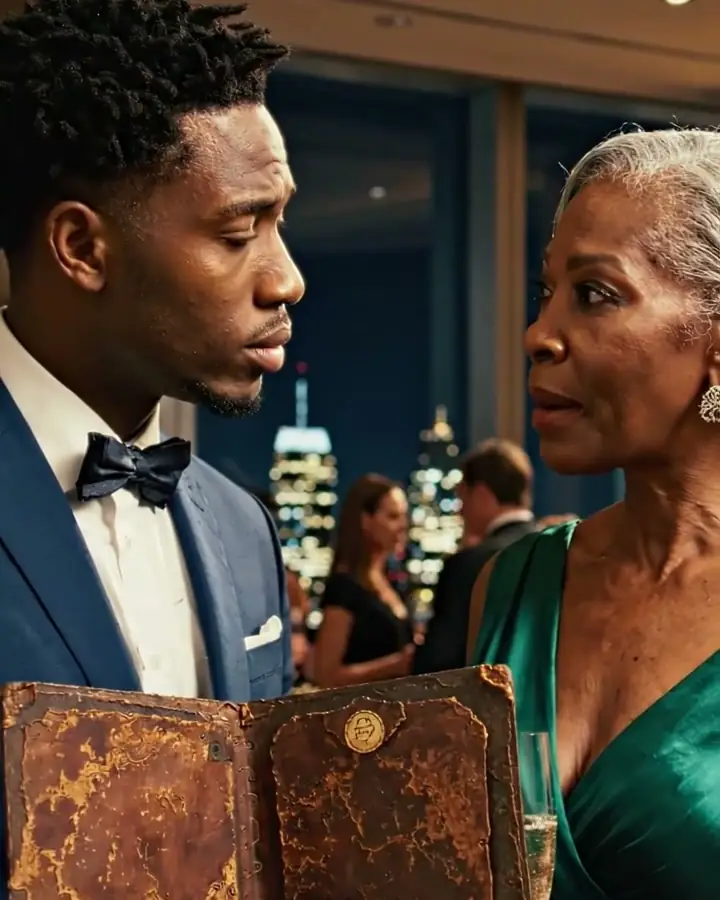
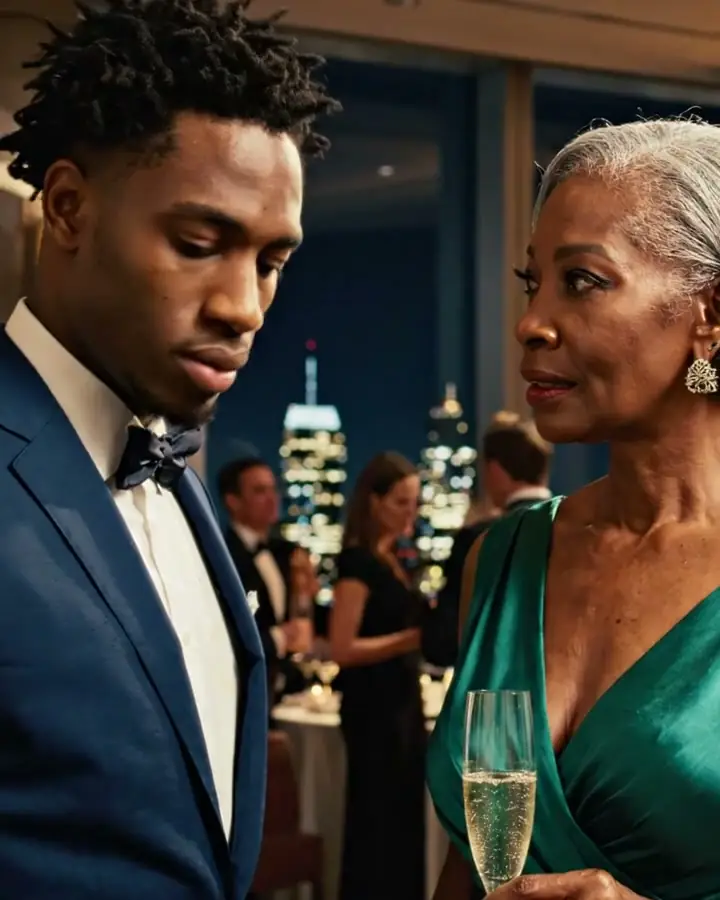
From across the room, Maya watched. She was a striking figure, her silver bob catching the soft rim light, the emerald silk of her gown flowing like liquid night. At forty‑eight, she carried the poise of someone who had spent a lifetime mastering the art of discretion. She was more than a confidante to Ethan’s mother; she was the quiet matriarch of the social circle, the invisible hand that steadied the family’s public image. Her eyes narrowed just enough for Ethan to sense that she understood the gravity of his discovery before he even pressed the button.
The Button’s Secret
When Ethan pressed the hidden button, a soft click resonated through the wall, and a concealed panel slid open with a whisper of old wood and metal. A narrow cavity was revealed, cradling a leather‑bound ledger whose cover was cracked with age, and a stack of letters sealed with dark wax. The air in the lounge seemed to thicken, as if the very walls were inhaling the secret that had been buried for decades. The partygoers, unaware of the drama unfolding behind the polished façade, continued their chatter, their laughter now a distant hum against the sudden hush that settled over Ethan’s immediate surroundings.
He lifted the ledger with reverence, the brittle pages crackling like old bones. “These papers… our hidden legacy?” he whispered, his voice barely audible over the distant hum of the city. The question hung in the air, a fragile thread linking past sins to present reckoning.
Maya’s gaze hardened, the silver of her hair reflecting a flash of resolve. “He built this empire on stolen land,” she replied, her tone a mixture of sorrow, accusation, and something else that Ethan could not quite place—perhaps a hint of redemption waiting to be claimed.
Uncovering a Dark Legacy
The ledger chronicled transactions that stretched back generations, each entry a meticulous record of deals that had reshaped the city’s landscape. The ink, faded but legible, spoke of parcels of land transferred under the guise of benevolent philanthropy, yet the fine print revealed contracts riddled with deceit. Names of indigenous families appeared alongside dates, each line a testament to promises broken and homes displaced.
Beside the ledger, the sealed letters lay in a neat stack, their wax seals bearing the insignia of a forgotten clan. Ethan broke the first seal with trembling fingers. The parchment inside was a plea, inked in a hand that trembled with desperation. “We ask for justice,” the letter read, “for the soil that nourished our ancestors, for the rivers that sang our children to sleep. We have given you our trust; we ask only for its return.” One after another, the letters unfolded stories of families torn from their roots, of crops that withered under new ownership, of children who grew up hearing the ghost of a language that the new rulers had tried to silence.
As Ethan leafed through the pages, the weight of his inheritance pressed upon him like a physical force. The glittering façade of his family’s wealth crumbled, replaced by a stark, undeniable truth that demanded acknowledgment. He felt the walls of the penthouse close in, not with the grandeur of marble, but with the suffocating presence of generations of unspoken guilt.
The Moral Crossroad
The party’s lively chatter faded into a hushed silence as guests sensed the shift in the room’s atmosphere. Conversations stopped mid‑sentence, eyes turned toward the center where Ethan stood, ledger in hand, the brass button still glinting behind him. In that moment, he stood at a crossroads: to conceal the scandal and preserve his family’s immaculate reputation, or to expose the truth and risk the collapse of everything he had ever known.
He turned to Maya, whose eyes reflected a mixture of regret and hope. “What will you do?” she asked, her voice soft but firm, as if she were already seeing the path he might take.
Ethan’s resolve hardened. “I won’t let them erase history,” he declared, his voice steadier than he felt. He lifted the ledger, feeling the weight of each page as a promise to the displaced families whose voices had been silenced for too long. “The world deserves to know. The truth belongs to those it has wronged, not to the ones who profit from its concealment.”
In that instant, the penthouse became less a symbol of power and more a crucible where a new narrative was forged. Ethan understood that his decision would reverberate far beyond the glossy pages of society magazines; it would ripple through the very foundations of the city’s history.
Repercussions and Redemption
The following morning, the city awoke to headlines that cut through the morning haze like a blade: “Penthouse Scandal: Dynasty’s Dark Foundations Exposed.” News anchors read aloud the entries from the ledger, the letters were displayed on scrolling tickers, and social media erupted with outrage, solidarity, and calls for justice. Public outcry forced the family’s corporation to issue a formal apology, acknowledging the injustices perpetrated by their forebears and pledging to initiate reparations for the affected indigenous communities.
Legal teams scrambled, historians were consulted, and a committee of activists and scholars was formed to oversee the restitution process. The corporation’s board, once insulated by wealth and influence, found itself under unprecedented scrutiny. Shares dipped, but the loss of reputation was far more severe than any financial hit could measure.
For Maya, the revelation marked a turning point. Once a silent enforcer of the family’s immaculate image, she stepped into the public eye as an advocate for restorative justice. She partnered with grassroots organizations, using her influence to secure land returns, fund cultural preservation projects, and establish scholarships for the descendants of those displaced. Her emerald gown was replaced, on many occasions, by attire that blended elegance with purpose—a visual reminder that true power lies in compassion as much as in wealth.
Ethan, now thrust into the role of a reluctant whistleblower, found himself navigating a new landscape. He testified before a congressional committee, his testimony echoing the pleas he had read in the wax‑sealed letters. He met with community leaders, listened to stories that had been suppressed for generations, and helped draft a framework for reparative measures that went beyond monetary compensation, focusing on cultural revitalization and legal recognition of ancestral lands.
Epilogue
Months later, Ethan returned to the same penthouse lounge, but the space had transformed. The glossy marble now bore subtle engravings of indigenous symbols, and the once‑exclusive gala tables had been replaced by a circular arrangement of chairs designed for dialogue. The brass button remained in its recessed niche, a silent sentinel reminding all who entered that beneath polished surfaces lie stories waiting to be heard.
Community dialogues filled the evenings, where activists, scholars, and former elites shared meals and ideas, forging a new narrative of accountability and healing. The ledger, once a hidden artifact, now rested in a public archive, its pages open for anyone to read, to learn, and to remember. Maya stood beside Ethan, no longer the enigmatic matriarch of secrecy but a visible partner in a movement that sought to rewrite history with honesty.
In the soft glow of the city lights, Ethan felt a peace he had never known within those walls. The hidden button had not only altered his destiny; it had sparked a broader movement toward truth and reconciliation. The legacy of a dark dynasty was being rewritten, not by erasing the past, but by acknowledging it, learning from it, and ensuring that the voices once silenced would forever echo through the corridors of power.
◆ ◆ ◆
Fiction. Any resemblance to real persons or events is purely coincidental.