Breathless Tales
The Forgotten Chauffeur: Truth Unveiled After Two Decades
The Forgotten Chauffeur: Truth Unveiled After Two Decades
The Night That Changed Everything
It was a night of relentless rain in March 2004, the kind that turns city streets into mirrors of the sky. A black Mercedes, the flagship vehicle of a prestigious luxury travel firm, roared into the downtown tunnel, its headlights cutting through the deluge like knives. Ahead, a delivery truck struggled to maintain traction, its cargo shifting with each splash of water. In an instant, the Mercedes surged forward, colliding with the truck in a violent embrace that sent metal fragments and shattered glass spiraling across the wet pavement. The sound of screeching brakes was swallowed by the roar of the rain, and then, as if the city itself held its breath, an eerie silence fell. Emergency lights flickered to life, painting the scene in a frantic red that reflected off the puddles.
Police arrived within minutes, their radios crackling with terse commands. Among the wreckage, a man in a dark navy chauffeur’s uniform stood, his crisp white shirt stained with rain and grime, his polished shoes half‑submerged in water. He was Michael Alvarez, a 55‑year‑old man whose life had been defined by punctuality, quiet diligence, and the soft hum of engine purrs beneath his fingertips. The officers arrested him on the spot, citing the vehicle’s black box as incontrovertible proof that he had been behind the wheel. The headlines the next morning were unrelenting: “Chauffeur Charged with Fatal Crash.” Yet Michael knew, with a certainty that burned like a cold ember, that he had been on a break that night, sitting in the company lounge, sipping coffee, far from the chaos of the tunnel.
Two Decades of Stigma
The verdict fell like a guillotine. Michael’s license was revoked, his job terminated, and the modest savings he had painstakingly set aside for his daughter’s education evaporated under the weight of legal fees and court‑ordered restitution. The courtroom, once a place of measured arguments, became a daily nightmare. Every siren that wailed through the city’s veins sent a jolt of terror through his heart; every flashing police car reminded him of the night that had become a scar etched into his very soul.
Friends turned away, colleagues whispered behind his back, and family members kept a cautious distance. The man who had once been the silent guardian of executives and dignitaries now walked the streets as a pariah, his uniform hanging in his closet like a relic of a life that no longer existed. He never spoke out, fearing that any protest would only deepen the wound, that his voice would be drowned in a chorus of accusation. He endured twenty long years of isolation, the weight of an injustice that was both invisible and omnipresent, until the day a new set of eyes began to look beyond the surface.
The Investigation Reopened
In 2024, Sara Patel, a thirty‑year‑old corporate investigator with a reputation for relentless tenacity, was hired by the now‑defunct luxury travel firm to conduct a routine audit of archived case files. Sara’s sharp mind and meticulous nature led her to the file labeled “2004 Mercedes Crash – Final Report.” Within the stack of police statements, court transcripts, and newspaper clippings, she found a reference to dash‑camera footage that had supposedly been deemed “corrupt” and discarded.
Her curiosity ignited. She requested the original media storage logs, and what she discovered sent a ripple through her professional resolve. A maintenance log, tucked away in a forgotten drawer, indicated that the dash camera had been swapped out two weeks after the crash—a detail conspicuously absent from any police report. The replacement had been logged as a routine upgrade, yet no mention was made of why the original unit was removed. Sara’s instincts told her that the answer lay within that missing footage.
She dug deeper, cross‑referencing text messages between Adrian Whitmore, the son of the firm’s late CEO, and an unknown mechanic. The messages were terse, laden with code: “The night is coming,” “Cover our tracks,” and a series of timestamps that aligned suspiciously with the night of the crash. A hidden backup on the company’s server, buried beneath layers of encrypted folders, contained the original dash‑camera video. When Sara finally played the file, the grainy footage revealed a man gripping the steering wheel, his face illuminated by the streetlights. The man’s forearm bore a distinctive tattoo—a stylized “W” intertwined with a serpent—that matched a known image of Adrian Whitmore.
The Confrontation and Revelation
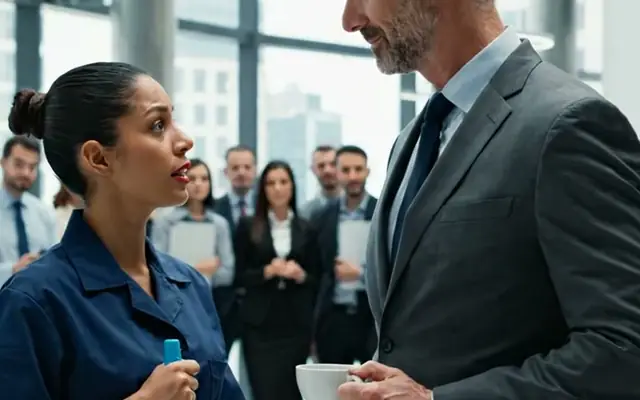
Armed with undeniable evidence, Sara arranged a private meeting in the grand lobby of the hotel where Michael had once been employed. The lobby, with its marble floors and towering columns, was filled that morning with a small audience of journalists, former colleagues, and curious onlookers. The air was thick with anticipation, each breath a silent question.
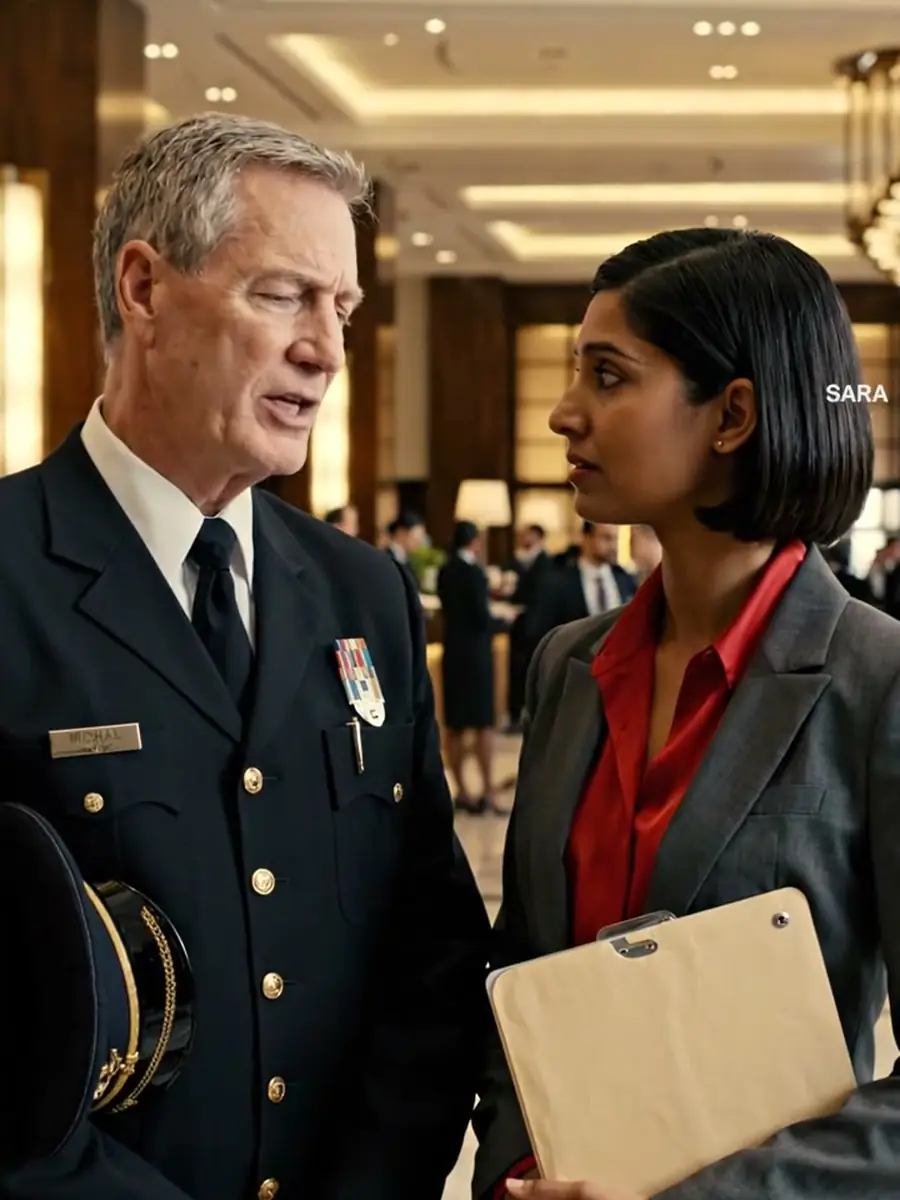
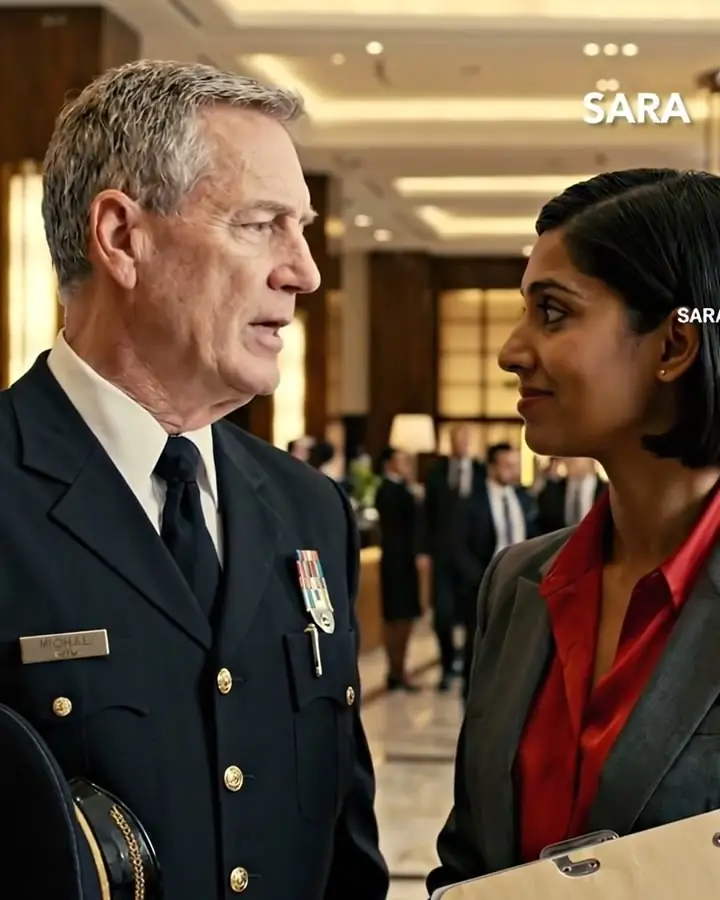
Michael stood on the left, still wearing his navy uniform, the crispness of his shirt a stark contrast to the weariness etched into his face. His posture was rigid, yet his eyes held a steadiness that spoke of a man who had weathered a storm and was finally ready to step into the light. Sara stood on the right, her tailored charcoal blazer and red silk blouse a visual echo of the confidence she carried. In her hand, she clutched a leather‑bound folder that contained the damning footage and the text messages that had led her to it.
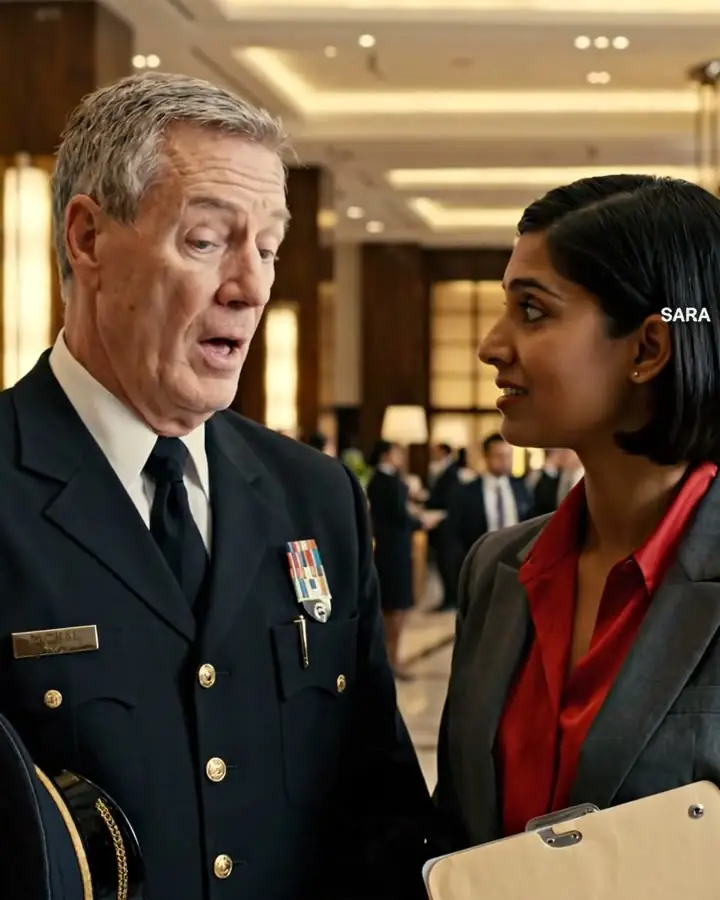
“They blamed me for the crash, I never drove that night,” Michael said, his voice trembling yet resolute. The words hung in the vaulted space, resonating with the murmurs of the crowd. He had spent two decades holding his breath; now he exhaled.
“We’ve found the dash‑camera footage, and it proves you’re innocent,” Sara replied, her tone a blend of triumph and compassion. The audience shifted, some gasping softly, others holding their breath as the gravity of the moment settled.
Without cutting, the camera lingered as Sara opened the folder, revealing a still image from the video—a young man with the distinctive tattoo on his forearm, unmistakably Adrian Whitmore. “The real driver was the CEO’s son, hidden for years,” Sara continued, her eyes never leaving Michael’s. “Now the world will hear my side.” Michael’s voice, hoarse from years of suppression, rose in a quiet affirmation: “Now the truth can finally breathe.” A faint smile broke through his years of anguish, a smile that held the promise of redemption.
Aftermath and Redemption
The footage was released to the public the same day, igniting a firestorm of outrage. Social media platforms erupted with calls for accountability, and the city’s mayor issued a formal apology in a televised address, acknowledging the miscarriage of justice that had haunted Michael for two decades. The court, upon review of the new evidence, vacated Michael’s conviction and ordered a full expungement of his criminal record.
Legal settlements followed swiftly. The firm’s remaining assets were used to compensate Michael for lost wages, legal fees, and the intangible cost of twenty years of stigma. A public acknowledgment of the injustice was displayed on the front of the courthouse, a permanent reminder that truth, though delayed, could still find its way.
With his name cleared, Michael reclaimed his driver’s license and returned to the road he loved. He accepted an invitation to speak at a national conference on wrongful convictions, his voice steady as he recounted the harrowing journey from accusation to exoneration. His speech was not just a personal catharsis but a rallying cry for reform in investigative procedures and the preservation of evidence.
Sara’s career skyrocketed. She was promoted to senior director of corporate compliance and became a leading advocate for transparency in corporate investigations. Her work sparked new legislation mandating the preservation of dash‑camera footage and stricter penalties for tampering with evidence. She traveled across the country, sharing her story with law firms, police departments, and corporate boards, ensuring that no other employee would be silenced by hidden evidence.
Epilogue
In the quiet moments after the headlines faded, Michael and Sara stood together in the same lobby where their confrontation had unfolded. The marble floor was now empty, the echo of their conversation lingering like a promise. The crowd that had once watched in stunned silence had transformed into a chorus of support, their applause reverberating through the vaulted ceiling.
Michael placed a hand on Sara’s shoulder, a gesture of gratitude that needed no words. “For twenty years, I lived in the shadow of a lie,” he said softly. “You brought the light.” Sara smiled, her eyes reflecting the soft glow of the lobby’s chandeliers. “Truth has a way of surfacing,” she replied, “but it takes people like you to keep it alive.”
The truth, once buried beneath layers of deception, had finally surfaced, proving that even the deepest wounds can heal when justice finally arrives. As they walked out of the lobby together, the rain outside had ceased, and the city’s streets glistened with the promise of a new dawn—a dawn where Michael could once again drive with confidence, and Sara could continue her relentless pursuit of transparency. Their story, now etched into the annals of the city’s history, stood as a testament to perseverance, the power of truth, and the enduring human spirit that refuses to be silenced.
◆ ◆ ◆
Fiction. Any resemblance to real persons or events is purely coincidental.